|

Among the most recent advancements of INCT-TB in the field of drug development, we could mention the publication of a promising chemical compound for the subsequent development of a chemotherapeutic agent for TB treatment (Paz et al. Novel 4-aminoquinolines: Synthesis, inhibition of Mycobacterium tuberculosis enoyl-acyl carrier protein reductase, antitubercular activity, SAR, and preclinical evaluation. Eur J Med Chem. 2023;245(Pt 1):114908. doi: 10.1016/j.ejmech.2022.114908). Another example of INCT-TB's advancement is the identification of new microproteins encoded by small ORFs (small open reading frames) not yet annotated in the M. tuberculosis genome through a proteogenomic analysis pipeline that utilizes Machine Learning tools (de Souza et al. µProteInS-a proteogenomics pipeline for finding novel bacterial microproteins encoded by small ORFs. Bioinformatics. 2022 Apr 28;38(9):2612-2614. doi: 10.1093/bioinformatics/btac115). The identification of new enoyl reductases in M. tuberculosis by INCT-TB (Hopf et al. Bacterial Enoyl-Reductases: The Ever-Growing List of Fabs, Their Mechanisms and Inhibition. Front Microbiol. 2022 Jun 16;13:891610. doi: 10.3389/fmicb.2022.891610) will allow a better understanding of the bacillus's biology and may reveal new molecular targets. Additionally, the introduction of the CRISPRi technique at INCT-TB enabled the identification of the enzyme DAHPS as a vulnerable target, providing experimental insights for the rational design of anti-TB chemotherapeutic agents (Galina et al. Evaluation of 3-Deoxy-D-Arabino-Heptulosonate 7-Phosphate Synthase (DAHPS) as a Vulnerable Target in Mycobacterium tuberculosis. Microbiol Spectr. 2022 Aug 31;10(4):e0072822. doi: 10.1128/spectrum.00728-22). The proteogenomic analysis, identification of new targets, and vulnerability studies will provide an experimental basis for proposing genetic modifications of the BCG Moreau Rio de Janeiro strain, and if the data are promising, its production will be carried out by FAP.
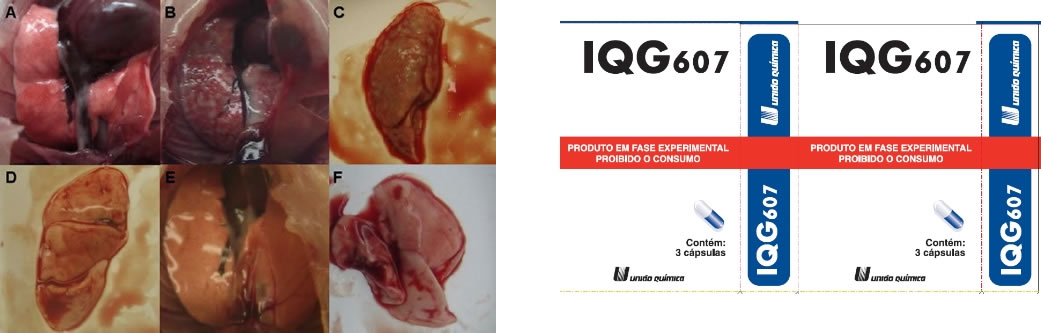
Representative images of lungs from (A) uninfected Swiss mice, (B and C) Mycobacterium tuberculosis H37Rv-infected and untreated mice, (
D) infected mice treated with isoniazid (INH) at 25 mg/kg and (E and F) infected mice treated with IQG-607 at 250 mg/kg after 28 days of treatment.
(Supplementary material from Rodrigues-Junior et al., Int J Antimicrob Agents. 2012; 40(2):182-5).
Experiments using early and late controls of infection revealed a bactericidal activity for IQG-607. IQG-607 might well represent a good candidate for clinical development as a new antimycobacterial agent. The compound will enter in clinical trial phase I in September 2013, financed by Brazilian Development Bank(BNDES).
2. Vaccine development
Our Immunological studies support the hypothesis that BCG vaccination induces distinct patterns of cell death during maturation of the immune system. Results of the analysis of oral vaccination of reinfected mice show the possibility of using BCG Moreau to reduce hemorrhagic process in TB. WHO International collaborative study established the BCG Moreau RJ as a TB vaccine Reference Reagent (RR) (NIBSC code 10/272). This is the only WHO RR Brazilian vaccine. (http://who.int/biologicals/expert_committee/BS_2200_WHO_RR_BCG_Moreau_BS_report.pdf).
3. New Diagnostic Methods
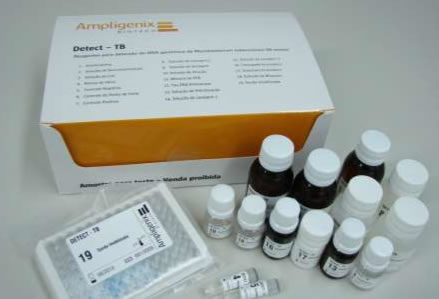
The best results were related to the development of molecular diagnostic test for TB, followed by the production of kits (Detect TB) by Brazilian industry: Labtest, registered in ANVISA in Nov 2012. Through pragmatic clinical trial, it is being evaluated the clinical and economic impact on the healthcare system in 5 states of the Federation, with the support of Decit-SCTIE-MS. If the impact is confirmed, it may incorporated by Unified Health System (SUS). In parallel, we are developing another molecular tests for the drug resistant TB, that shown excellent results on accuracy, and we initiated interface with industry for the production of kits and further evaluation in SUS.
Were identified immunogenetic and inflammatory biomarkers for prediction of TB infection, TB disease, poor outcome during treatment and relapse. In September 2012, we began cooperative activities with Fiocruz-Tecpar/Parana (INCT) for joint development of molecular tests and immunogenetic markers through platforms. Among the phenotypic tests, we developed a filter membrane that enables increased clinical samples yield similar to obtained with culture. The prototype in its 4th version has been tested in Manaus and Vitoria. It is planned to evaluate this version in other sites in the country in early 2014.Partnership was initiated UFMG and FURGS with another national industry (Plastlabor) to produce commercial kit of culture medium with nitratase to diagnose drug-resistant TB - Established a clinical and economical for the next semester. We have also initiated interaction with company Orange Life for test development POINT OF CARE, serological MTP64 detect antigen associated with the smart reader.